|
During this week's lecture, Rhiannon talked about a different art school following on from the Bauhaus lecture last week. We learnt about the 'school of design' in Ulm - Hochschule fur Gestaltung. I found it really interesting hearing about what was important to the school and how it changed over the years, and subsequently the reasons for why it was shut down. I am going to research further Max Bill who was a significant figure during this period.
Born in 1908, Max Bill was a Swiss artist and designer who specialised in combining maths and geometry into his art practise. As an ex student of the Bauhaus, he later co-founded the HfG in Ulm where he was the head through the 1950s. He specialised in architecture and product design during his time at HfG, however his work fell into many categories including painting, sculpture and graphic design. Max Bill later resigned from HfG due to conflict regarding how the school should progress. There was no doubt that he was an outstanding artist/designer, but the school needed to focus more on industrialisation and manufacturing to gain income, rather than the art aspects, and Bill struggled with this concept.
Although, Max Bill's teaching career didn't end here, he was later involved with other schools for example the State School for Fine Arts in Hamburg. He received many art awards throughout his career and died at the age of 85 in 1994 during a visit in Berlin. Today, he is probably most recognised for his wrist watches which are manufactured by the German brand Junghans.
0 Comments
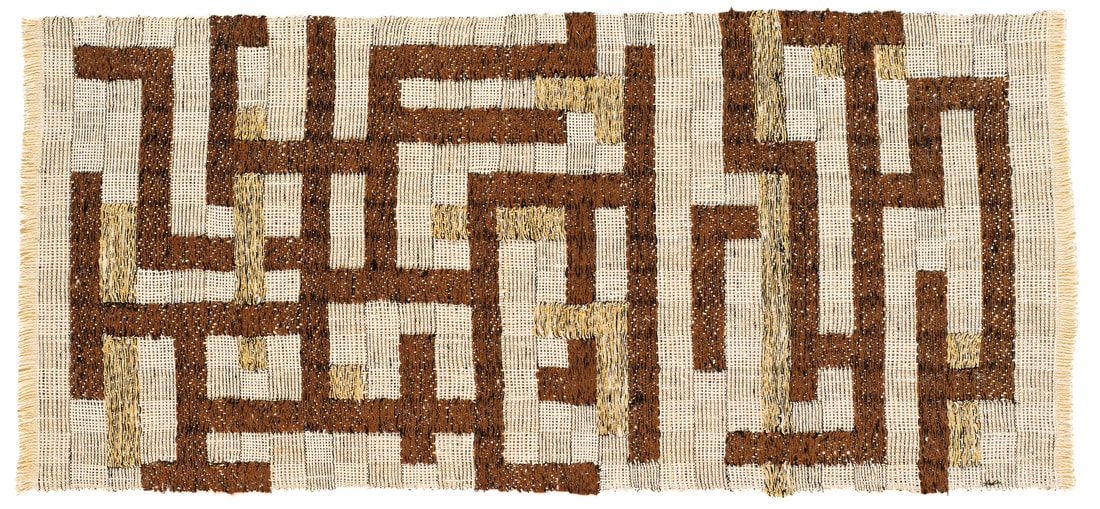
During this week's lecture, we had Rhiannon talking about the Bauhaus which I found really interesting as I never knew much about the art school. It was fascinating learning about all the artists who were involved with the Bauhaus and I have researched the one who intrigued me the most - Anni Albers.
Anni Albers, born in Berlin 1899, enrolled at the Bauhaus art school in 1922. The Bauhaus was founded by Walter Gropius in 1919 and it consisted of many different specialist workshops including sculpture, joinery, ceramics, printing and advertising, stage craft and many more. Anni Albers enrolled onto the weaving workshop. It was in fact here where she met Josef Albers who she married in 1925. Albers gained her diploma in weaving in 1930 and took over, from Gunta Stolzl, as head of the weaving workshop the following year.
Due to the closure of the Bauhaus in 1933, Josef and Anni Albers emigrated to the United States where they were invited to teach at Black Mountain College, an experimental art school in North Carolina. There, they lead the art programme together until 1949. In the same year, Anni held a solo textiles exhibition at the Museum of Modern Art in New York. Following a change in Josef Albers' teaching career, the pair moved to Connecticut in 1950. Anni Albers kept experimenting with hand-weaving through until the 1960s when she started introducing printmaking. Albers created mesmerising pieces, with roots of ancient and traditional textile techniques that she had learned from across the globe. Anni particularly took inspiration from objects and materials from which she felt had a communicative role within certain cultures. I really like the way in which all aspects of colour, composition, pattern, line and texture are expressed through her work and I really like the modern outlook it had especially at the time.
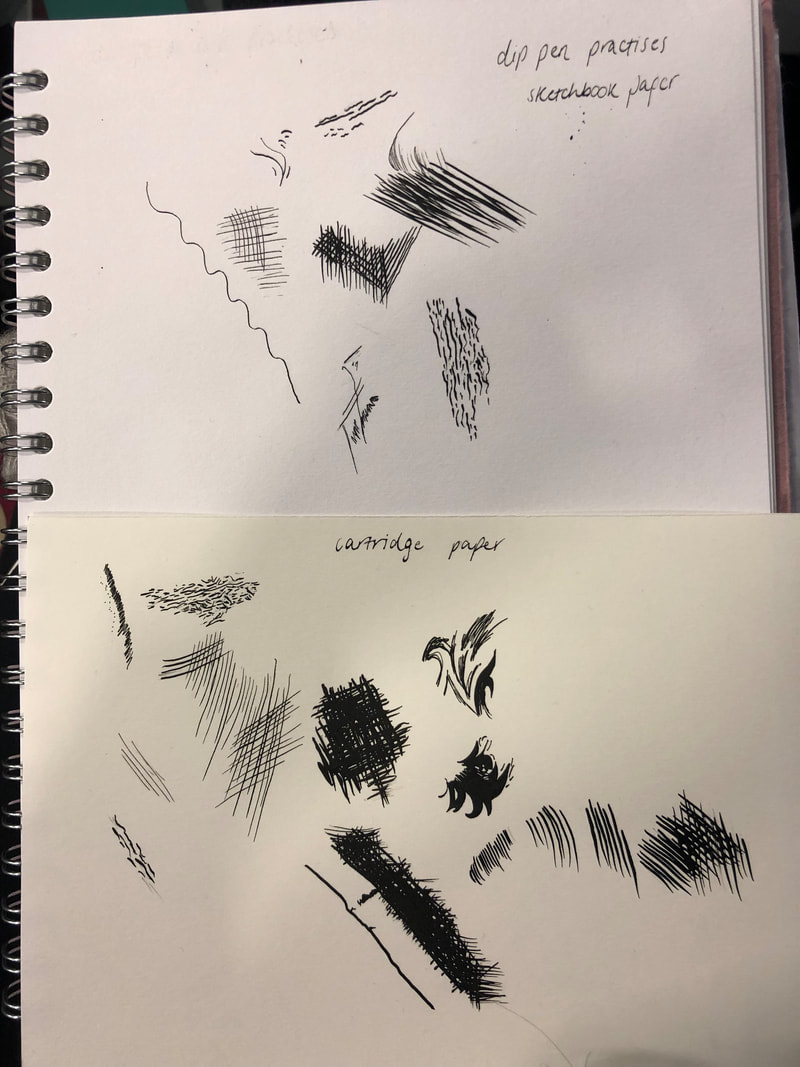
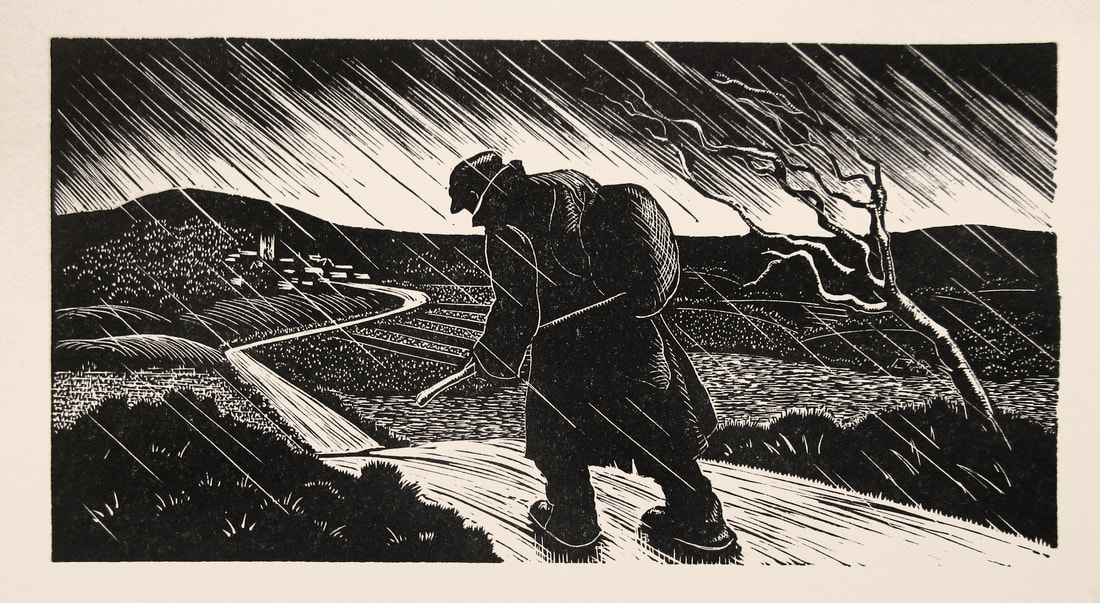
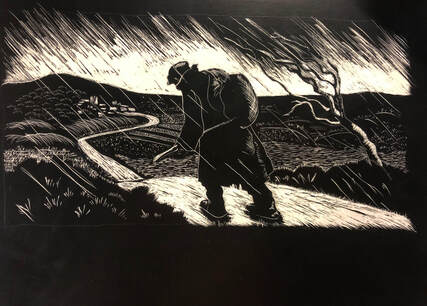
Project 2 involved us recreating 3 different pieces, all which have a different media. One piece in pencil, one in ink and one using scraper board. This was a very interesting brief, which I really enjoyed as it really helped develop skills.
put in with the rubber. I think I managed the cross hatching technique well - applying the colour down to allow good contrast of tones - however I think the marks in my piece look slightly harsher than Robertson's.
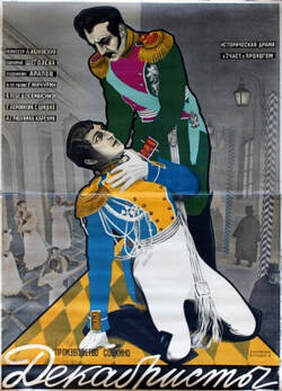
Nick's recent lecture involved modernism, cubism and Russian constructivism. We looked at the innovation and expansion of the arts during this period which was really interesting. We looked into 3 of the main cities - Paris, Milan and Moscow, and I will be focusing on constructivist posters in this blog and exploring the key attributes.
The photo montage aspects within the poster are particularly powerful due to subject of the image. Furthermore, one distinct aspect of Rodchenko's posters is the geometric, diagonal format which is successful. Although it is very simple, it is a good way of portraying a message clearly and cleverly to ensure the audience can understand it.
In conclusion both posters were very successful in their time, but both served two different purposes. The propaganda poster by Rodchenko was to deliver a message and the Stenberg Brothers poster was advertising a movie. Due to the type of audience, both used a similar bold font, easy to understand and portray the message, or express emotion.
During this week's history lecture, Tony moved on to Art Nouveau which I enjoyed as I'm finding it really interesting moving through the decades each week. I was intrigued to realise that the movement of Art Nouveau differed between different European countries as I thought it had particular characteristics through them all. The two different motives are nature and geometry for this movement and it differs between cities. Architect A H Mackmurdo, from the Arts and Crafts Movement was one of the biggest influences for this era due to his curved, linear, natural details, which carried through to Art Nouveau. One of the main cities I'll start with is Glasgow. Charles Rennie Mackintosh is definitely a significant name when it comes to this movement due to his huge success. Despite nature being a big drive for this era, Mackintosh was mainly influenced by geometry. He cleverly used his Scottish heritage to produce Celtic inspired pieces, lacking curves and ornamentation. Known for his geometric furniture and his recognisable celtic rose motifs, his work has moved through the movements. Therefore, Mackintosh was the main inspiration for the Art Deco which follows this era. The Viennese loved the work of Mackintosh. Art Nouveau in Vienna was mainly lead by Koloman Moser, Josef Hoffman, Joseph Maria Olbrich and Gustav Klimt. Mackintosh was the main inspiration for Josef Hoffman. Architecture was a strong element of the era and the Secession building (1897) was probably the biggest feature of this movement in Vienna, which was built by Joseph Maria Olbrich. The building also contains a mural by Gustav Klimt which is definitely of the Art Nouveau period. This is where Glasgow and Vienna differ as Vienna was heavily inspired by nature - featuring lots of linear, ornate decoration. Spain also have their own take within this movement. Gaudi was one of the main artists through this era, with his extraordinary architecture. Heavily influenced by nature, Gaudi created Parc Guell (Barcelona) and La Sagrada Familia which have gothic, oriental details. Ceramics were also one of his loves, along with architecture, and iron sculpture often featured. It is clear how this differs from Glaswegian art due to the curved linear details, in comparison with the strong geometry from Mackintosh. The Casino de Madrid, a social club of the early 19th century also has details of Art Nouveau with its ornamentation and oriental exterior. Nancy, a northeastern French region, is the last location I will cover. Known for its Art Nouveau character, Nancy contains many beautiful churches and palaces, along with wrought iron sculptures, filling the medieval areas. It is obvious that Nancy was inspired greatly by nature due to the lack of geometry, particular reference to leaves/greenery and animals, and a clear Japonism influence. The main artists include Louis Majorelle and Émile Gallé, and their work strongly differs from that of Mackintosh due to the curves. The glass work of Émile Gallé clearly highlights nature and the furniture of Mackintosh and Majorelle are complete opposites.
This week, Tony held a lecture about the Aesthetic Movement, looking at how Japan influenced art and design throughout Western culture. It became clear that, from the 1860's, many artists such as Van Gogh, Whistler and Degas, were being greatly inspired by Japanese art, particularly Ukiyo-e (wooden block prints). Before this time, Japanese art wasn't really valued due to the fact that there was no industrial society. However, it became much more popular once the craze for collecting Japanese art began - where the first samples were seen in Paris. Vincent Van Gogh was greatly inspired by Japanese art. For example his piece 'Japonaiserie: tree in bloom' (1887), is almost a replica of a particular piece from Hiroshige, 'Flowering plum tree in the Kameido garden' (1857). Van Gogh had learnt the importance of vivid colours by the Ukiyo-e masters, and therefore chose to copy some of Hiroshige's pieces, using bold, brilliant colours. Due to the fact that Japanese art was hidden for so long from the West, when Japan eventually opened up to the world, the prints were an instant hit since they differed so significantly with their bold colours and their clever use of space. Therefore, when Van Gogh discovered this influence, he used it to make his own work more interesting and exotic. If you look at Van Gogh's early works, such as 'The Angelus' (1880), we can see a drastic difference particularly in the use of colours since he only used dull colours during this period. In my opinion, his work before the Japanese influence especially lacks boldness, in both terms of colour, subject, and composition. Another artist who was inspired by Japonism was Gustav Klimt. A significant characteristic of the Japanese art is the pillar format, which Klimt used frequently in the late nineteenth century. One of his pieces 'Three children and a young woman' (1898), which I found in the book 'Japonism" by Thames and Hudson, uses this pillar format. It was a popular composition due to the fact you could produce spatial illusions that couldn't be achieved in a standard frame. Klimt could have been influenced by the piece 'Night scene: young girl on a horse with a young man' by Isoda Koryusai (1770s) which demonstrates a 'snapshot' with lots of detail, where a close up is thoroughly explored. One of Klimt's older pieces, 'Seated Young Girl' (1894), is completely different however. This piece is struck with a traditional appearance, which in my opinion lacks interest in comparison to pillar pictures, and we can therefore see that there was a significant change in Klimt's work throughout this era. In summary, it is clear that Japonism was a key movement in regards to the western culture, where artists were mainly influenced by the Ukiyo-e wood block printing. Japonism provided inspiration for various elements such as colour, composition, subject, and more, and we can see the drastic shift in artist's work.
|
Ailsa ForresterIllustration student at the University of Cumbria. Archives
December 2019
Categories |









 RSS Feed