|
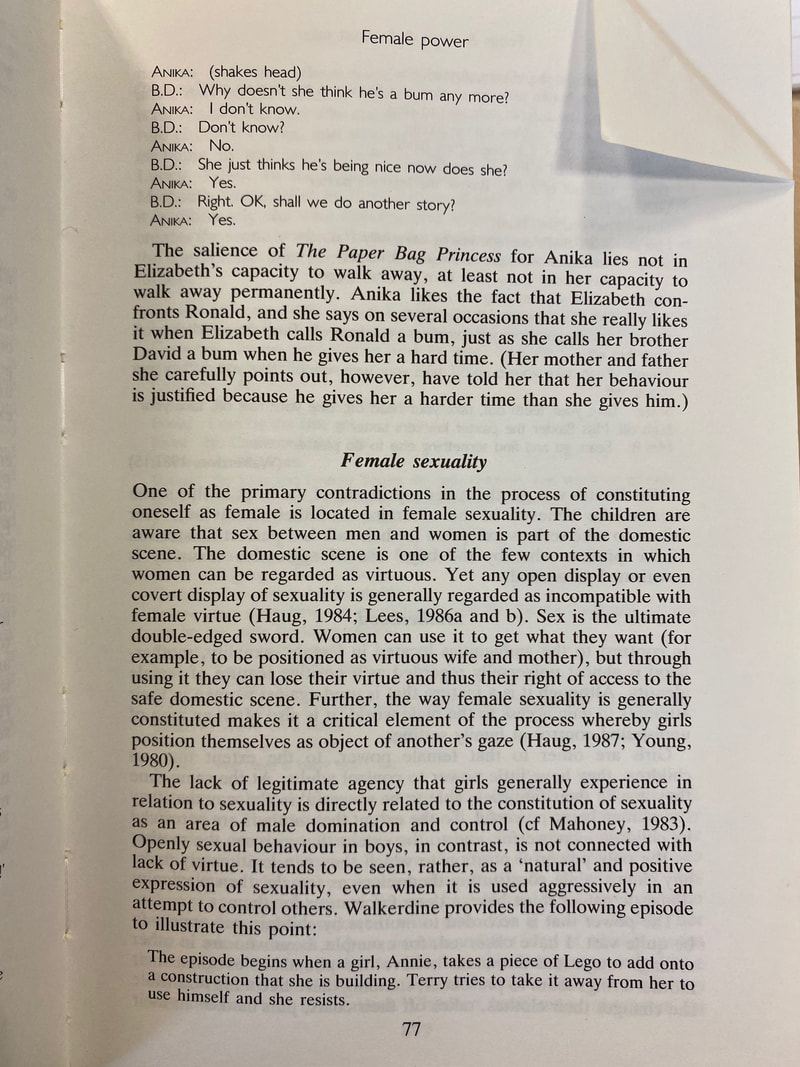
I read this book, published in 1989, which discusses ‘how and why children become masculine or feminine’. It further mentions that ‘the way in which gender is constructed in our society means that in learning to be people, to be members of our society, children must learn the way maleness and femaleness is done and they must get it right’. Bronwyn Davies studies to provide detail of the gendered world of childhood and new insights into the social construction of gender.
For me, I think considering the time this study was carried out, it is not surprising that this was the outcome. Sexism and gender stereotyping was still very much common and it seems optimistic to think that the outcome here would’ve been different.
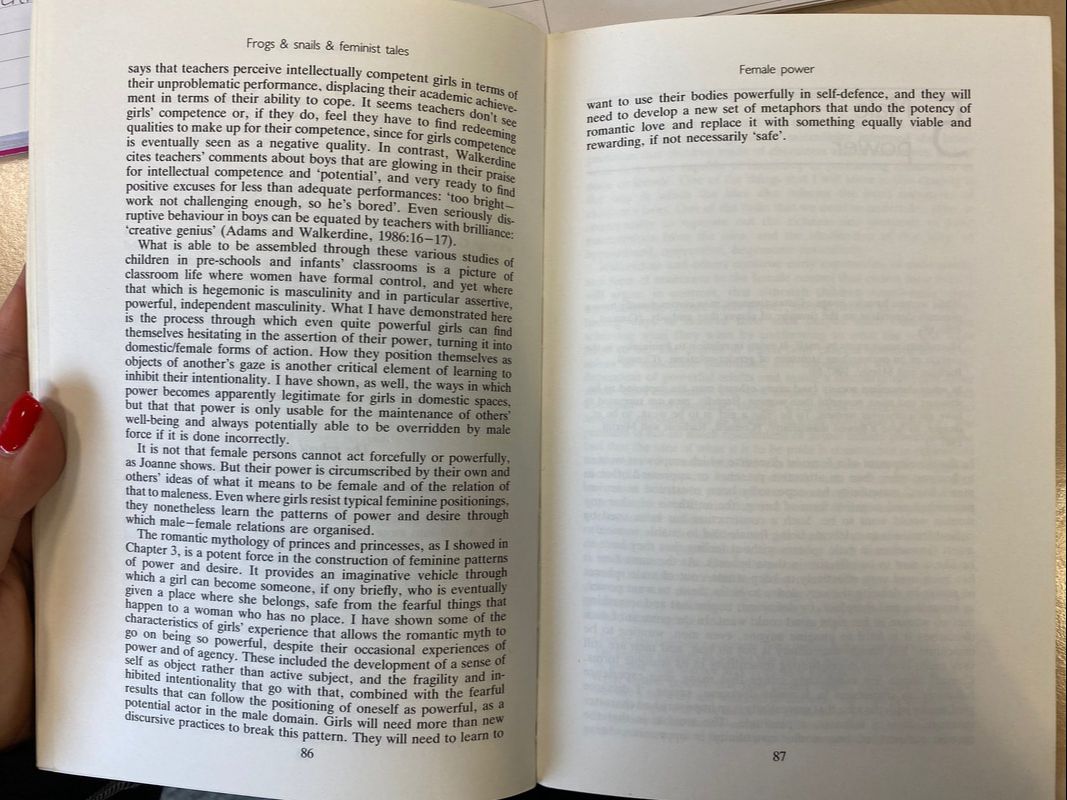
Pages 86/87 discuss how female power differs from that of a male. Rather than power as body strength, and can be used much more tactfully, in ways which a male might struggle. “Their power is circumscribed by their own and others’ ideas of what it means to be female and of the relation of that to maleness”. Davies also highlights that in order for there to be a change in this pattern, females will ‘need to learn to want to use their bodies powerfully in self defence, and they will need to develop a new set of metaphors that undo the potency of romantic love and replace it with something equally viable and rewarding, if not necessarily ‘safe’.’ I think this is a particularly strong and inspiring statement. It highlights a need for change, in a time where this was probably quite non-conformative. Male power: One of the main things which stood out to me in this chapter was the way that the reactions of the children backed up and evidenced the idea that male power equals domination. See page 91. Page 109 mentions the ways that males and females are allocated roles which involve particular behaviours. Males are portrayed powerful, contrasting with those of a female who appear weak, ‘complementary and supportive to that power’. Conclusion: The conclusion I found quite fascinating. “At the heart of the idea of maleness seems to be the idea of power as male power, with females having power only in the domestic realm or as helpers of men in the male sphere.” Another element I found in the conclusion was the ways in which Davies addresses how this idea is embedded in the narrative structures of children’s books, which consequently affects their attitudes towards themselves and others as they develop - “attitudes they develop towards themselves either as active agents who can and should act powerfully in a public sphere, or as sexualised beings whose agency is profoundly inhibited through the positioning of themselves as the passive recipients of another’s gaze.” - see page 138. Page 141 - Davies finishes the conclusion with the need for more communicative practises for children - the belief that they should not need to comply with a label of ‘male’ or ‘female’, or ‘boy’ or girl’ and the behaviours and characteristics these labels expect. “They need access to forms of discursive practice where their social practice is not defined in terms of the se too genitals they happen to have.” It is fair to say I found this book very eye-opening, and particularly fascinating considering the era it was written in. Although it isn’t really current enough in terms of the present day problems surrounding gender representation in children’s literature, it is interesting enough to see how this has previously been addressed and researched.
0 Comments
Leave a Reply. |
Author3rd Year Illustration Student Archives
November 2021
Categories |




 RSS Feed